
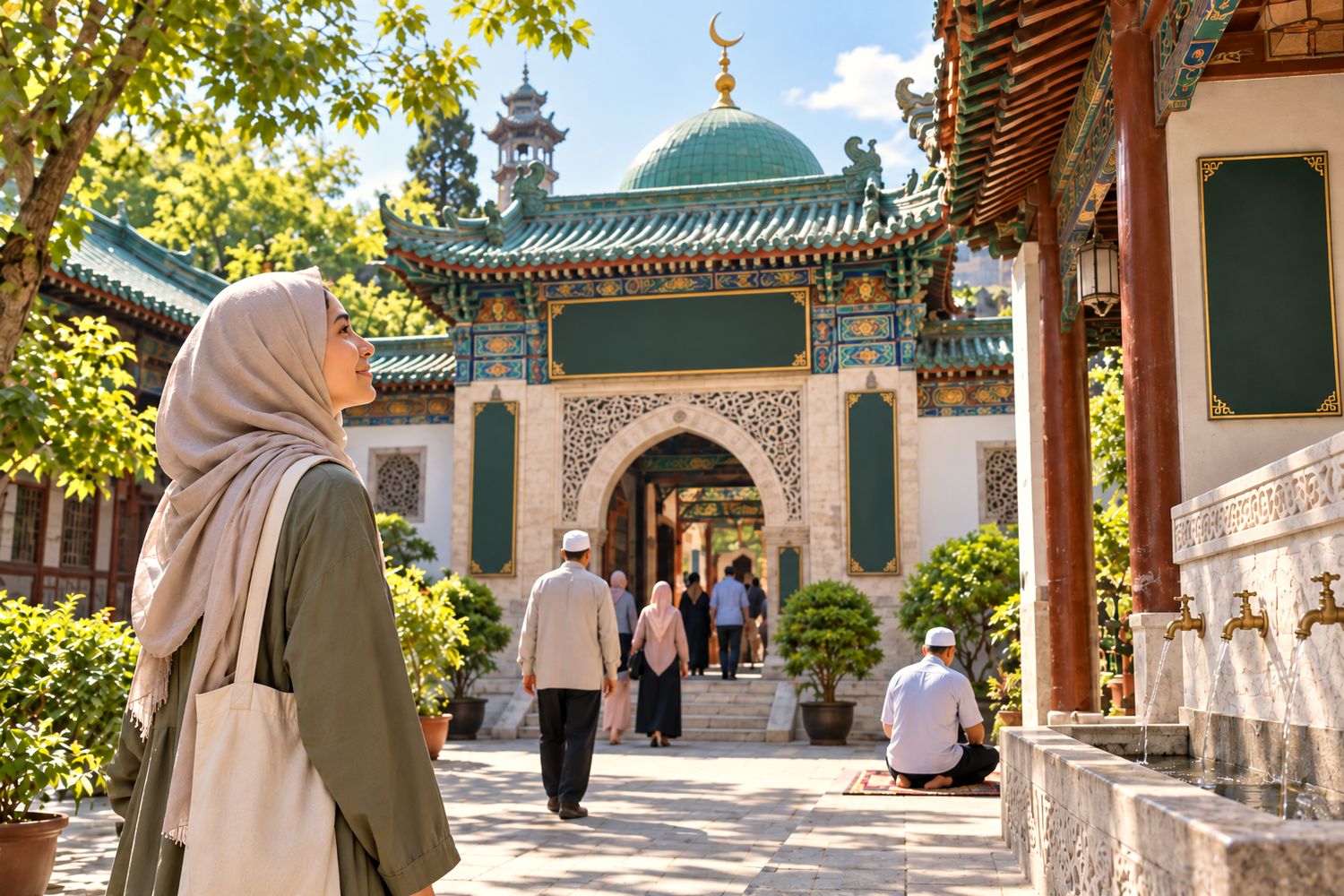
The short answer
- Major cities have active mosques, and several, like Niujie in Beijing and the Great Mosque of Xi'an, are among China's oldest.
- Prayer halls are for Muslims. Visitors dress modestly; women cover their hair.
- Friday prayer times vary by mosque. Confirm the time locally the day before.
- Use a prayer-time app with a qibla compass: prayer times differ between cities.
- Halal food streets often sit around the mosque, which makes lunch after prayer easy.
Short on time? We plan every halal meal, prayer and Friday prayer into your schedule. Muslim-friendly journeys → Or ask us anything: free answer within 24 hours.
Mosques in the main cities
| City | Mosque | Notes |
|---|---|---|
| Beijing | Niujie Mosque, Xicheng District | Beijing's oldest and largest; halal food streets around it. Metro Line 7, Guang'anmennei. |
| Beijing | Dongsi Mosque, Dongcheng District | Historic mosque near the city centre. |
| Xi'an | Great Mosque of Xi'an, Huajue Lane | Traditionally dated to the Tang dynasty; built like a Chinese temple, inside the Muslim Quarter. |
| Shanghai | Xiaotaoyuan Mosque, 52 Xiaotaoyuan Street, Huangpu | Shanghai's largest mosque (1917), home of the Shanghai Islamic Association. Metro Lines 8 and 10, Laoximen. |
| Shanghai | Huxi Mosque, Changde Road | Active mosque with halal food nearby. |
| Guangzhou | Huaisheng Mosque, Guangta Road, Yuexiu | One of the oldest mosques in China. |
| Hangzhou | Phoenix Mosque, Zhongshan Middle Road | One of the oldest mosques in China. |
| Chengdu | Huangcheng Mosque, Qingyang District | The city's best-known mosque. |
Visiting a mosque
- Dress modestly: long sleeves and trousers; women cover their hair.
- Remove shoes before the prayer hall.
- Visit outside prayer times if you are sightseeing, and ask before taking photos.
- Some historic mosques charge visitors a small ticket; Muslims coming to pray can ask at the gate.
Friday prayer
- Times vary by mosque and season. Your host or hotel can confirm the time the day before.
- Arrive early; popular mosques are busy.
- Ask in advance about the women's prayer area.
Praying while you travel
- Hotels: ask for a room where you can pray and a prayer mat if needed. Keep a compass app for the qibla.
- Sightseeing days: plan a quiet corner or a nearby mosque around Dhuhr and Asr. Large parks and museums rarely have prayer rooms.
- Airports and trains: some large airports have prayer or quiet rooms; allow extra time.
- Wudu: a small travel bottle helps on long days out.
We build prayer times and mosque visits into every Muslim-friendly journey. See also Halal food in China.
Questions
Can I attend Friday prayer in China as a visitor?
Yes. Muslim visitors join Friday prayer at active mosques such as Niujie in Beijing, the Great Mosque of Xi'an and Xiaotaoyuan in Shanghai. Times vary, so confirm locally the day before. Ask about the women's prayer area in advance.
Can non-Muslims visit mosques in China?
Many historic mosques welcome visitors outside prayer times and some charge a small entrance fee. The prayer hall is usually for Muslims only. Dress modestly.
Which direction is the qibla in China?
From China the qibla is roughly to the west. The exact direction varies by city, so use a qibla compass app.
Rules change. We re-check this guide regularly; confirm details before you travel or ship.